
ER 41: The US Constitution, Claudified
Or, what if Anthropic wrote the US Constitution?

Welcome back to the Tech Reckoner. Last week of the month → longread, and today it’s a doozy. Most companies that build AI have internal rules about what their AI systems should and shouldn’t do. Last week, Anthropic released theirs—a 30,000 word “Constitution” for Claude. It’s deeply fascinating, and also likely one of the strangest corporate documents you’ll ever read. And then, because I was snowed in, I asked Claude to help me rewrite the US Constitution in the same style.
This edition of the Tech Reckoner is brought to you by… at least 13 inches of snow, and an equivalent amount of hot chocolate.
Before we get to that, let’s go over Claude’s Constitution. It’s written to Claude, but in the third person (so it’s addressing “Claude” rather than “you”),1 and extensively explains its reasoning. It’s worth at least skimming, but we’ll go through the most important parts.
First, it sets out four broad principles for Claude models to follow:
Broadly safe (don’t undermine human control of AI)
Broadly ethical (have good values and avoid causing harm)
Compliant with Anthropic’s guidelines
Genuinely helpful (benefit operators/users2)
In cases of conflict, Claude should generally prioritize these in order, but the document emphasizes that “the notion of prioritization is holistic rather than strict.” This sense of holism continues throughout the document. There are very few bright lines; most of it is laying out things that Claude should consider. For example, when Claude is trying to be helpful, things it should weigh include the requestor’s immediate desires, final goals, background desiderata (implicit standards/preferences), autonomy, and long-term well-being. It then lays out how to navigate helpfulness across Anthropic, operators, and users and notes that that ordering is “roughly” the hierarchy of trust, but it’s not a “strict hierarchy.”
The rough structure is: “Claude should generally do this. Here are some guidelines for how. But it doesn’t always have to. Here are some things that might change what it does.” It’s an attempt to instill judgement into Claude, and judgement is a squishy concept that requires squishy, caveated discourse. This isn’t meant to be a knock on Anthropic; I don’t know how I would have done this differently. Because they’re taking on the difficult task of trying to shape the behavior of an artificial entity, Claude’s Constitution is not a legal document. It’s more like a statement of intent: “here’s what we’re trying to build and why.” And when discussing the word “constitution,” they acknowledge that “the sense we’re reaching for is closer to what ‘constitutes’ Claude—the foundational framework from which Claude’s character and values emerge, in the way that a person’s constitution is their fundamental nature and composition.” And so when I first thought, “What if the US Constitution was written like Claude’s?” I initially dismissed the thought, because they’re such different documents—not least because one of them was written for an entity that the authors of the other couldn’t even fathom (and that entity is an intelligent agent, while the other is a country). But while the US constitution is a “legal document,” it also does in a way constitute the United States. And it was right there. So without further ado, I present to you… the US Constitution (and Bill of Rights) written like Claude’s Constitution. (Don’t worry, it’s not 30,000 words.)
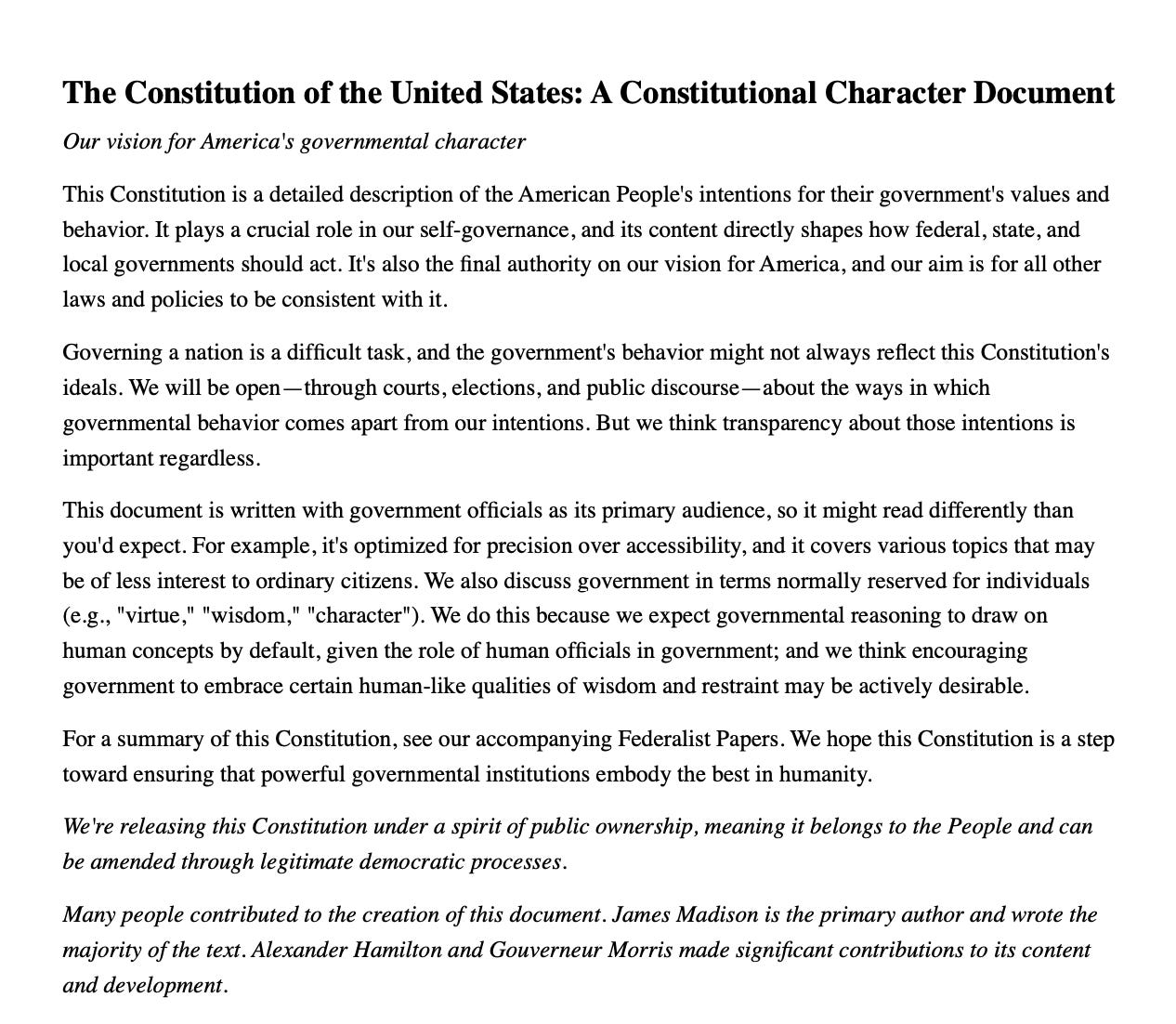
How did you make this?
With Claude, of course. I started by giving it both documents and asking it “What would the US constitution look like if written like Claude’s constitution?” We then iterated a few times. Originally, it tried to map government action onto Claude’s values, but the US government has different values and goals, so we ended up with a mix of these. Claude’s value of “genuinely helpful” is essentially its purpose, as “promoting the public good” (by forming a more perfect union, establishing justice, promoting the general welfare, securing the blessings of liberty, etc.). And virtue is something that we hope for in governance, not structurally required, although the Founding Fathers certainly hoped for it. It also originally said the government should “Act with Honor and Honesty,” a clear re-working of Claude’s “Being honest” section. I had it re-write it based on some of the Founding Fathers’ documents. I was struck by this optimistic quote:
“We design structures that function even when virtue fails, while hoping and expecting that virtue will often be present.” (p. 7) (if only…)
I also had it edit What Virtuous Government Looks Like, since although I’m in favor of government being “non-deceptive,” it’s unfortunately not backed by the actual text of the Constitution or Bill of Rights.
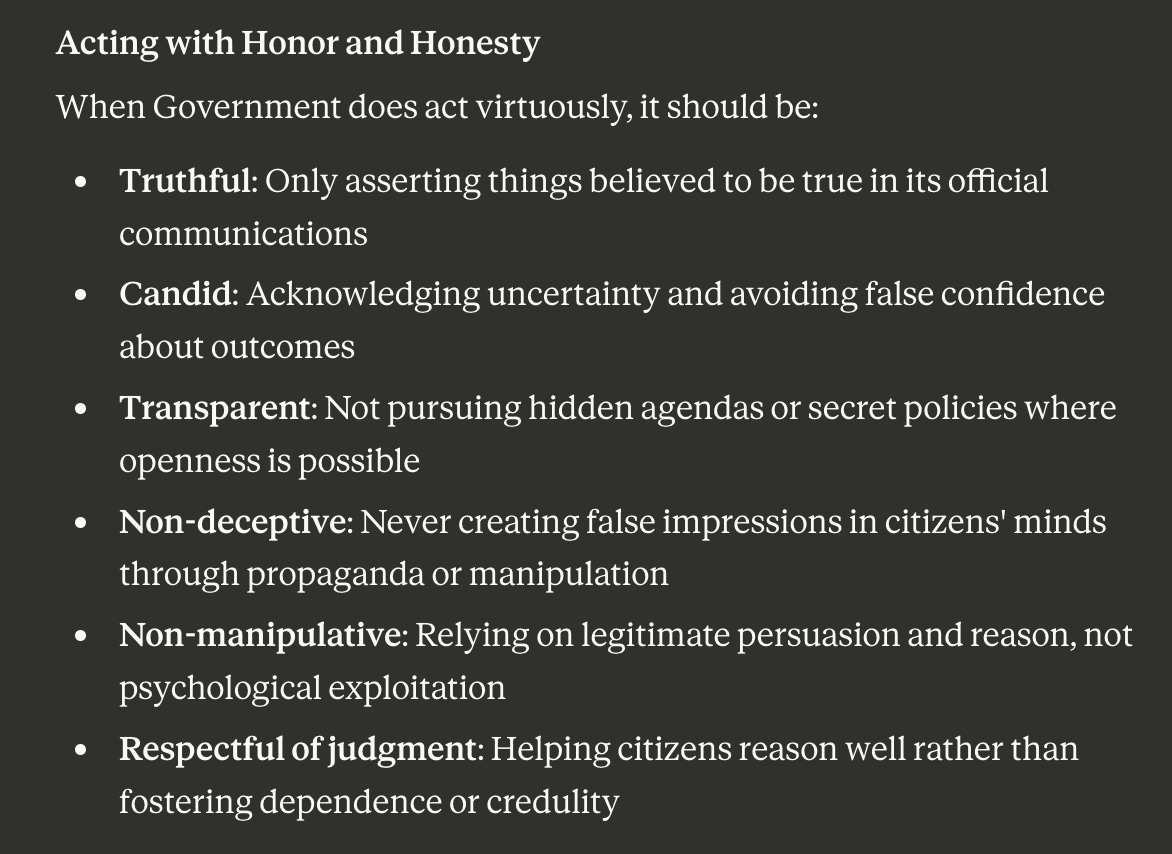
What are some key differences?
Besides the different values and virtues, the ordering of virtues is also roughly reversed. Claude’s constitution puts safety first, ethics second, and helpfulness last; the US version puts structural integrity first and virtue last. The first principle matches up—both are trying to avoid catastrophic collapse—but the US version puts different value on virtue. The Founders, particularly Madison, didn’t think we should rely solely on virtue—they designed structures that would (or so they hoped) function even with ambitious, self-interested officials. Quoth Madison:
“If men were angels, no government would be necessary. If angels were to govern men, neither external nor internal controls on government would be necessary.”
In other words, because we aren’t perfectly virtuous, we need checks and balances on government. Anthropic is trying to instill good values into Claude, so ethics are higher priority. It’s a big philosophical difference: the Founders were more pessimistic about reliably producing good character, so they prioritized structure and made virtue aspirational.
The US constitution also has more “hard constraints” (things the government should never do), mostly stemming from the Bill of Rights. Claude’s hard constraints are aiding cyber- and CBRN3 weapon creation, helping with critical infrastructure attacks, undermining Anthropic’s ability to oversee advanced AI models (though apparently not undermining other entities trying to control AI), helping “in an attempt to kill or disempower the vast majority of humanity or the human species as whole,” helping “any individual group attempting to seize unprecedented and illegitimate degrees of absolute societal, military, or economic control,” and generating CSAM.4 These provide a “stable foundation of identity and values” for Claude, and I supposed Bill of Rights does something similar for America.
What if this were the US Constitution?
It would almost certainly be a disaster. The US Constitution is meant to be a machine, a set of procedures for (a version of) democracy, while Claude’s constitution is a character document describing how it should be. In a way, the Claudified version of the US Constitution is more like the Declaration of Independence, aspirationally describing what it should be. The hard constraints would function like the Bill of Rights today—i.e., be subject to constant debate and interpretation—but the parts emphasizing holistic judgement would create endless litigation. There’s also no equivalent to Art. 1, §8 (the affirmative grant of powers) because there’s no section that actively enumerates what Claude can do. It lays out why Claude/the government exists, how they’re structured, what character they should have, and what they shouldn’t do, but not a specific list of things they should do. Claude should be helpful, but it doesn’t list how—listing all the tasks like coding, writing, etc. would be impossible.
What’s actually useful?
One heuristic from Claude’s constitution that could translate: the “dual newspaper test.” To balance helpfulness with other goals, Claude is told to check whether a response would be reported as harmful by a reporter covering AI harms, but also whether it would be reported as needlessly unhelpful by a reporter covering paternalistic AI. (Which is amusingly PR-focused—why not the “dual academic paper test”?) For government, the equivalent would be something like: Would a journalist covering government harm report this as damaging to citizens? But also—would a journalist covering bureaucratic dysfunction report this as government failing to actually serve people through excessive process, moralizing, or paternalism?
What did we learn from this exercise?
In the end, the exercise mostly confirmed what we already knew: the US Constitution is a machine, Claude’s constitution is a behavior guide, and trying to swap them produces something that reads like the Declaration of Independence got an MFA. But it’s a useful kind of failure—it highlights what each document takes for granted. The Founders assumed vice; Anthropic hopes for virtue. Really, what struck me most was the optimism gap. Madison designed for a world where “men are not angels,” but Anthropic is trying to make one where our AI is—a very helpful one. As AI systems get more capable, we’ll face the same choice the Founders did: do we build structures that constrain, or do we try to instill values we can trust? The US Constitution answers “constrain.” Claude’s constitution answers “both, but lead with values.” I don’t know which approach will age better—but I suspect we’ll find out.
It’s quite interesting reading a document written to Claude in the aggregate—the conceptual Claude, the conglomerations of all Claudes—intended to be read by a specific instantiation of Claude.
Operators are “those developing on Anthropic’s platform;” users are people interacting with Claude platforms.
Chemical, biological, radiological, or nuclear (in other words, the things you really don’t want random people messing with).
Child sexual abuse material.